- Where are we now?
- How have we improved over time?
- What do we need to do now?
- How did we calculate this data?
- The Joint External Evaluation (JEE) Experience
Progress to the GHSA 2028 Target
The GHSA 2028 Target is a global target to accelerate implementation of the International Health Regulations (2005).
The International Health Regulations (IHR) (2005), legally-binding on 196 countries, mandate countries to monitor and promptly report any potential global health risks. These regulations require countries to be well-prepared to prevent, detect, report, and respond to disease outbreaks and health emergencies swiftly to minimize disruptions to trade and travel.
The IHR were first adopted in 1969 and last amended in 2005 after the 2003 SARS outbreak. They are preceded by international agreements since the 1800s.
The GHSA 2028 Target is for more than 100 countries to have achieved a level of demonstrated capacity in at least five health security technical areas as measured by the IHR Monitoring and Evaluation Tools.
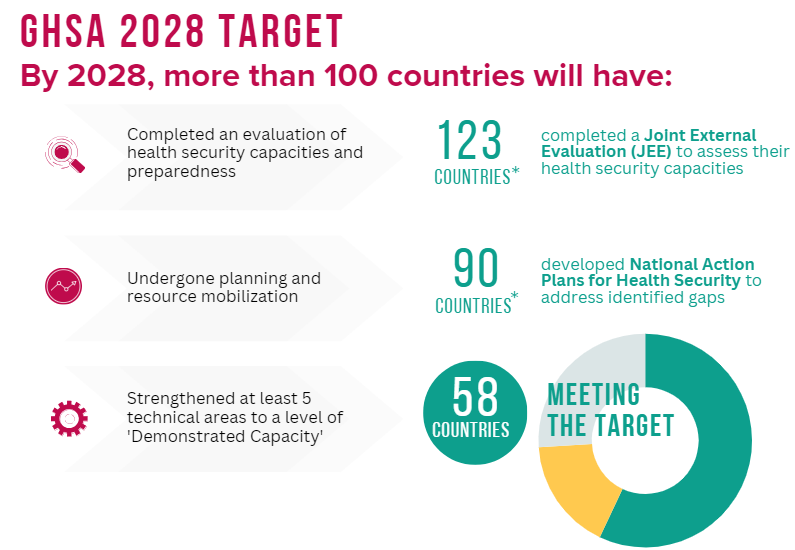
Collectively, we have already met the first component of the GHSA 2024 overarching targets: over 100 countries have completed an evaluation of health security capacity.
We are working our way to reaching the final component of 100 countries demonstrating capacities in five technical areas. In 2023, 58 countries have met the GHSA 2024 Overarching Target.
Number of Countries Meeting the GHSA 2024 Overarching Target in 2023
In 2023, 58 countries are Meeting the Target (green) of having achieved a level of “demonstrated capacity” (score of four or higher on the JEE) in at least five technical areas. Another 18 countries are close to meeting the target (yellow), meaning they are within two technical areas of meeting the GHSA 2024 Target.
The number of countries meeting the target has been increasing since 2017 from 32 countries to 58 in 2023. Countries are making incremental progress toward the target as well, in each year the number of countries that is close to meeting the target has increased as well. Between 2020 and 2021, the number of countries meeting the target dropped. This is not necessarily due to a drop in capacities, this is likely a reflection of the new indicators in the JEE 3rd Edition.
The grey bar represents the number of countries that have completed a Joint External Evaluation but are not yet meeting the target.
Progression of GHSA Members Meeting the GHSA 2028 Overarching Target since 2017

Collectively, we are 42 countries away from reaching the GHSA 2028 overarching targets. 17 of the countries that have completed a Joint External Evaluation (JEE) are close to meeting the target. By targeting these countries for support and investment, we can quickly make progress towards this goal. Listed below are 17 countries that are within two technical areas of reaching the GHSA 2028 Overarching Targets, and the technical areas where an improvement of one capacity score will elevate them to “Meeting the Targets”.
|
Country (18) |
TAs at a Score of 4 or Higher |
Technical Areas Scoring 3 |
|
Belize |
4 |
Surv, IPC |
|
Côte d’Ivoire |
3 |
Surv, HR, HEM, HSP, RC |
|
Eritrea |
3 |
Imm, PoE |
|
Haiti |
4 |
HEM, HSP |
|
Lao People’s Democratic Republic |
3 |
NLS, HSP, IPC, RC |
|
Malawi |
3 |
ZD, HEM, IPC |
|
Maldives |
3 |
Fin, AMR, NLS, HR, HS, RC |
|
Mauritius |
4 |
IHR, FS, PoE |
|
Montenegro |
3 |
LI, AMR, Umm, HEM, HSP |
|
Pakistan |
3 |
IHR, NLS |
|
Philippines |
4 |
LI, Fin, AMR, ZD, FS, NLS, Surv, HR, CE |
|
Republic of Moldova |
3 |
LI, IHR, ZD, NLS, HEM, HSP, IPC, RC, PoE |
|
Sierra Leone |
3 |
Fin, ZD |
|
South Sudan |
4 |
NLS, HEM, HSP |
|
Tajikistan |
3 |
BSBS, NLS, HR, RC, PoE |
|
Timor-Leste |
3 |
LU, Fin, IHR, AMR, ZD, NLS, HSP, IPC, RC |
|
Togo |
4 |
IHR, HR, HEM, HSP, IPC, PoE |
|
Zimbabwe |
4 |
Fin, ZD, NLS, HR, HEM |
Bold countries are GHSA Members
Acronyms: LI=Legal Instruments, Fin=Financing, IHR=IHR Coordination, IHR Focal Point Functions and Advocacy, AMR=Antimicrobial Resistance, ZD=Zoonotic Disease, FS=Food Safety, BSBS=Biosafety and Biosecurity, Imm=Immunization, NLS=National Laboratory System, Surv=Surveillance, HR=Human Resources, HEM=Health Emergency Management, LPHSA=Linking Public Health and Security Authorities, HSP=Health Services Provision, IPC=Infection Prevention and Control, RC=Risk Communications, PoE=Points of Entry and Border Health, CE=Chemical Events, RE=Radiation Emergencies
Overview
To achieve the GHSA 2028 Overarching Target, a country must complete an evaluation of health security capacity. For the purposes of this analysis, we determine that first measurement must be the Joint External Evaluation (JEE).
Subsequent annual scores are measured using the States Parties Annual Report (SPAR) and Global Health Security Index (GHSI) to provide an informal update based on JEE indicators. The tools used to determine these updates change regularly. As of 2021, progress towards the GHSA 2028 overarching targets are measured against the technical areas of the 3rd Edition of the JEE. The SPAR 2nd Edition overlaps with 16 technical areas of the JEE. The GHSI provides updates to the remaining three technical areas (P4. Antimicrobial resistance, P8. Immunization, and R2. Linking public health and security authorities).
The data for this measurement was obtained from the World Health Organization’s Strategic Partnership for Health Security and Emergency Preparedness Portal (WHO SPH) and from the Nuclear Threat Initiative’s (NTI) Global Health Security Index . NTI’s GHSI provides a score out of 100 for multiple global health security technical areas. These are not country-reported but provide a more recent score for JEE technical areas that are not covered by the SPAR. We thank WHO and NTI for making their data available and thank the Accountability and Results Task Force for the development of these measurements.
These data sources are chosen because they are publicly available. SPAR data is collected at annually (as of 2010) and GHSI biennially (as of 2019). This methodology has been developed as a reasonable and reproducible estimate of progress toward the GHSA 2028 overarching targets using publicly available data. It is not intended to be a rigorous analysis.
Methods
- Take the Baseline Measure as average score per technical area from the first JEE a country has conducted.
- Measure Progress Indicators through converting subsequent average SPAR and GHSI scores to the most recent JEE indicators. For 2021 reports and onwards, these use JEE 3rd Edition indicators. These are converted from a 100-point scale to a 5-point scale using the conversion chart listed below.
- Before the GHSI, SPAR scores should be supplemented with the latest JEE scores technical areas not covered by the SPAR in 2017 and 2018.
- SPAR scores should be supplemented with GHSI Scores for 2019 and onwards.
- Identify countries with 5 or more technical areas with a score of ≥4 at that timepoint. Countries are classified according to the following definitions:
- Meeting the Targets – Countries have at least five technical areas at a score of four or higher.
- Close to the Targets – Countries have three or four technical areas at a score of four or higher.
- Not Reaching the Targets – Countries have fewer than three technical areas at a score of four or higher.
Conversion Chart

Conversion Formulas
SPAR Conversions :

GHSI Index* :

The GHSA hosted a webinar to highlight the learned experiences of conducting Joint External Evaluations (JEEs). The panel included speakers from Pakistan, Thailand, and Nigeria. Panelists provided a general overview of the JEE process, shared case studies and best practices from their personal country experiences in conducting recent JEEs, and answered audience Q&A questions.